

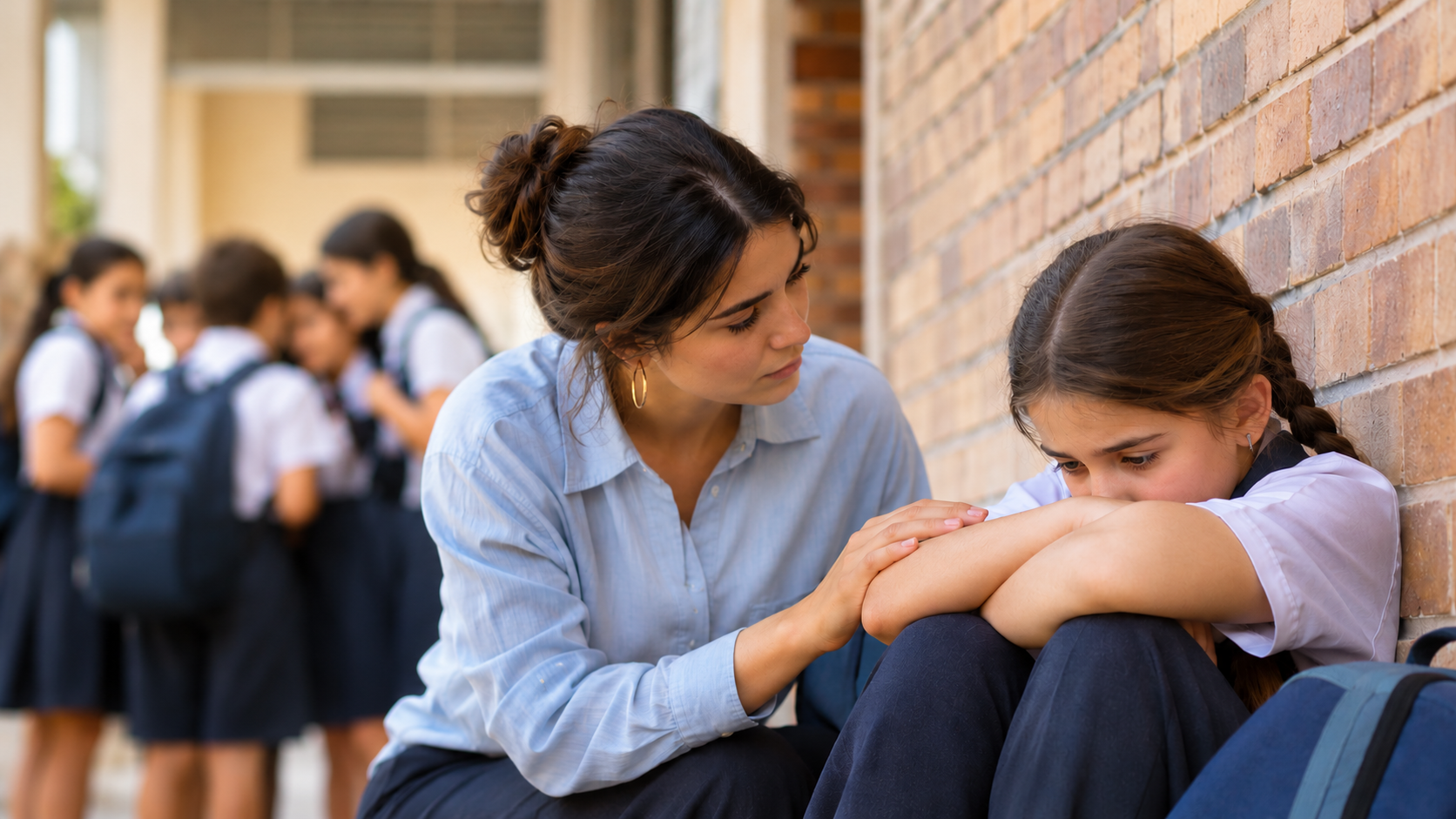
What is bullying and how can you support your child?
“They're just joking.”
“These things happen among children.”
“Let him learn to defend himself.”
Disagreements, arguments, and sometimes unpleasant behavior can occur between children in school life. However, it is not right to treat every conflict as an ordinary childish argument.
Sometimes a child is bullied, teased, excluded from a group, physically abused, or continuously targeted online for a long time.
This could be bullying. Bullying is not just a child having a “bad day” at school. When it continues, it can seriously affect a child’s sense of safety, school life, emotional well-being, and social relationships.
The most important thing is this: the child does not have to deal with this situation alone.
What is bullying?
Bullying is usually explained by three main characteristics: intent to harm, repetition of the behavior, and an imbalance of power between the parties.
That is, not every argument is bullying. It is another situation when two children argue once and then resolve the problem. It is a different situation when one child is constantly kept in a weaker position than the others, subjected to insults or exclusion (UNICEF, Bullying: What is it and how to stop it).
UNESCO also considers bullying as one of the most widespread forms of school violence and emphasizes that this behavior is a social process related to the imbalance of power between individuals and groups (UNESCO, Defining school bullying).
Bullying can take many forms.
- Physical bullying
Hitting, pushing, taking or damaging objects, or physically obstructing a child.
- Verbal bullying
Insulting, calling people names, constantly mocking and threatening.
- Social bullying
Deliberately excluding a child from a group, spreading rumors about them, and encouraging others not to talk to them.
- Cyberbullying
Insults, threats, ridicule or the dissemination of personal information via social networks, messaging apps, gaming platforms and other digital means.
One of the particularly difficult aspects of digital bullying is that the pressure doesn't always stop when a child comes home from school.
Bullying should not be seen as a “childhood experience”
Sometimes adults can look back on their childhood experiences and say, “It was like this in our time too.” But just because a behavior has existed for a long time does not make it harmless.
According to UNESCO, more than 30 percent of students worldwide report experiencing some form of bullying, and school violence can affect children's educational, physical, and psychological well-being (UNESCO, What you need to know about school violence and bullying).
Not all children who are bullied react the same way.
Someone immediately tells their parent about it.
The other is silent.
Someone doesn't want to go to school.
The other one becomes more nervous than before.
Therefore, just waiting for the child to say, “I'm being bullied” may not be enough.
Why might a child not talk about bullying?
If the child is silent, it does not mean that there is no problem.
He may think:
“If I tell you, the situation will get worse.”
“They won't believe me.”
“They will think I'm weak.”
“They'll take my phone away from me.”
“My parent would come to school and raise the issue in front of everyone.”
Sometimes a child doesn't fully understand that what's happening to them is bullying. That's why a parent's reaction is so important. When a child finally decides to talk, the first response they get can influence whether they want to seek help in the future.
What to say if a child tells you about bullying?
The first need is not to immediately “solve” the problem. It is to listen to the child first.
“Why didn't you answer?”
“Weren't you able to defend yourself?”
“Maybe you did something too?”
Questions like this can make a child feel guilty.
Instead:
“Thank you for telling me this.”
“I'm sorry for what happened to you.”
“You won't be alone in this.”
“We'll think about what we can do together.”
that is to say creates a safer start.
It is important that a child who is experiencing bullying is listened to openly, not blamed, and the situation is resolved together.
“Why is it not enough to say ”figure it out yourself"?
It is important for a child to develop independent problem-solving skills. However, since bullying is characterized by a power imbalance, it is not right to place all the responsibility on the child who is targeted.
Sometimes adult intervention is necessary. Especially if there is physical violence, threats, persistent insults, cyberbullying, or a risk to the child's safety, cooperation with the school and other responsible persons is necessary.
UNESCO recommends a “whole-education approach” to preventing bullying – that is, an approach that involves school administrators, teachers, students, parents, and the community. Clear school rules, a safe classroom environment, and timely responses to incidents are key components of this approach (UNESCO).
What steps can a parent take?
First, it is useful to calmly learn what the incident is.
Who is participating?
How long has the incident been going on?
Where does it happen?
Who else has seen this?
If there is digital bullying, possible evidence – messages and screenshots – can be saved. It is more useful to then contact the school and take a solution-oriented, rather than accusatory, stance. The goal is to create a safe environment for all children before “punishing the other child.” At the same time, it is important to tell the child what steps will be taken. Sudden intervention without their knowledge can sometimes make the child feel completely out of control.
“An approach like, ”I think it would be helpful to talk to your teacher in this situation. How do you think we can do this?” engages him in the process.
A child who is being bullied may also need support.
When talking about bullying, it is easy to oversimplify the problem by simply dividing children into two groups: “good” and “bad.” Bullying behavior is unacceptable and should be clearly stopped. But it can also be important to understand why the child who engages in the behavior behaves the way he does. Sometimes a child’s difficulty regulating their emotions, the role models they see at home or school, the need to gain social status, and other factors can play a role.
This does not excuse bullying. On the contrary, it allows us to understand the root of the problem instead of just punishing it.
The most powerful message you can give a child
Bullying can change a child's attitude towards themselves. They:
“I have a problem.”
“Nobody wants me.”
“I am weak.”
he may start to think.
That's why the message he received at home is especially important:
“The way others treat you does not determine your worth.”
Staying with your child won't solve all their problems in one day. But it will meet one of their most important needs: knowing they're not alone in this situation.
Preventing bullying is not just about telling a child to “be strong.” School, family, and society must work together to create an environment for children where violence is not normalized and respect is a part of everyday behavior.
Because every child has the right to go to school feeling safe, not afraid.
READ THIS TO UNDERSTAND CHILDREN: The role of parental care in a child's life